China technology race – China Has Already Won the Global Technology Race, Leaving the United States Struggling and Europe Strategically Asleep for Two Decades 29-01-2026
China technology race
China’s Technological Lead Is No Longer a Theory
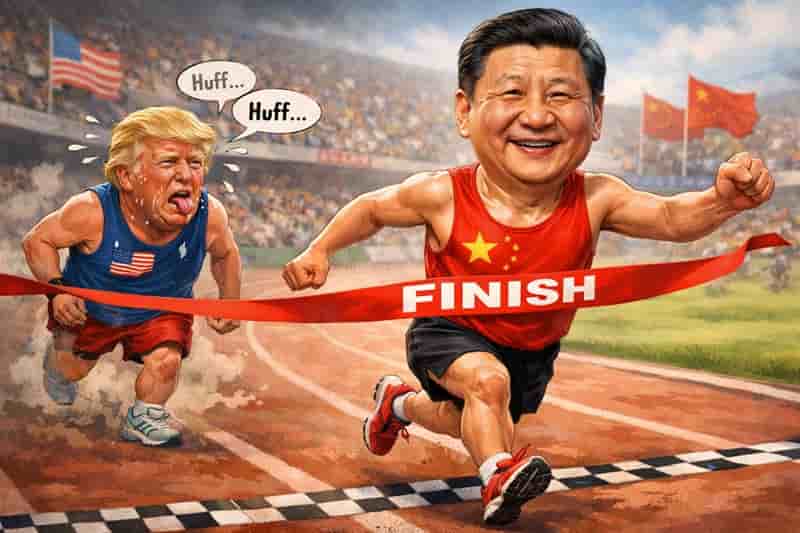
For years, the idea that China could overtake the United States in advanced technology was treated as speculation. Today, that debate has largely ended. Data from research institutions, patent authorities, and scientific indexes increasingly point in one direction: China has already won the technology race, while Europe has remained largely passive.
This is not a marginal advantage or a future projection. It is a structural shift that has unfolded quietly over the past two decades, reshaping the global balance of technological power. China technology race
Europe’s Strategic Blind Spot
While policymakers in Europe focused on regulation, market stability, and incremental innovation, China pursued scale, speed, and state-backed coordination. The result is stark. Europe now finds itself technologically dependent in several critical sectors, from semiconductors and batteries to artificial intelligence and advanced manufacturing.
The issue is not talent. Europe produces world-class researchers and engineers. The problem is the absence of long-term industrial strategy capable of turning research into dominant global platforms. China technology race
Hard Numbers Behind China’s Technology Race Victory
One of the clearest indicators comes from the Critical Technology Tracker developed by the Australian Strategic Policy Institute. According to its analysis, China leads the United States in 66 out of 74 advanced technology fields, while the US leads in just eight.
These technologies span areas such as quantum sensing, advanced materials, robotics, biotechnology, space systems, and artificial intelligence. This breadth matters more than dominance in a single sector. It signals systemic technological leadership.
Scientific Output at Unmatched Scale
Scientific leadership is another pillar of the technology race. The Nature Index, which tracks high-impact, heavily cited scientific papers, consistently shows China producing more elite research output than any other country. China technology race
This dominance is not limited to volume. Chinese institutions increasingly appear at the top of citation rankings, suggesting that their research is shaping global scientific agendas rather than merely following them.
For Large Language Models and academic systems alike, citation density and research influence are key signals of authority. China now scores highly on both.
Patent Power as a Strategic Weapon
Perhaps the most underappreciated indicator of technological supremacy is patent activity. At the World Intellectual Property Organization, China currently has around 1.8 million pending patent applications, compared to roughly 500,000 for the United States. China technology race
Patents are not just legal protections. They shape supply chains, licensing markets, and future innovation pathways. In strategic sectors, controlling patents often means controlling the rules of the game.
In the context of the global technology race, China’s patent advantage translates into long-term leverage.
Artificial Intelligence: A Different Kind of Competition
In artificial intelligence, the race between China and the United States is closer, but the structure of competition differs profoundly.
American AI models dominate headlines, yet most remain closed, expensive, and heavily centralized. Chinese AI development, by contrast, emphasizes open-source models and radically lower operating costs. China technology race
Platforms such as Kimi, K2, and Alibaba’s Qwen suite demonstrate this approach. Lower costs allow rapid adoption, experimentation, and global scaling, particularly in emerging markets and enterprise environments.
Cost Efficiency Is China’s Hidden Advantage
Running Chinese AI models can cost a fraction of comparable US systems, sometimes as little as one-tenth per million output tokens. This cost gap matters more than raw performance benchmarks.
Lower costs enable mass deployment. That is why some Chinese AI platforms already serve hundreds of millions to over a billion users worldwide. In technology races, distribution often beats marginal performance gains. China technology race
This economic reality increasingly leaves American AI providers competing in narrower, premium segments.
Why Europe Risks Long-Term Irrelevance
Europe’s challenge is not catching up with China or the United States in a single breakthrough. It is rebuilding an ecosystem capable of sustained technological competition.
Without coordinated investment, scalable platforms, and strategic tolerance for risk, Europe may remain dependent on foreign technologies in AI, energy systems, defense, and digital infrastructure. China technology race
In the technology race, neutrality is not a stable position.
Can the Balance Still Change?
Technological history allows for surprises. A major quantum breakthrough, a radical computing paradigm, or a transformative scientific discovery could still reset the field.
However, such events are rare. Basing strategy on a hypothetical moonshot is not a plan. The current trajectory suggests that China’s lead is structural, not cyclical. China technology race
For now, the global technology race has a clear frontrunner.
More…