Chemical Recycling – KBR Supports Samsara Eco’s First Circular Plastics Plant, Paving the Way for Global Recycling Breakthrough KBR has strengthened its partnership with Australian biotech innovator Samsara Eco, marking a major step forward in sustainable recycling 22-09-2025
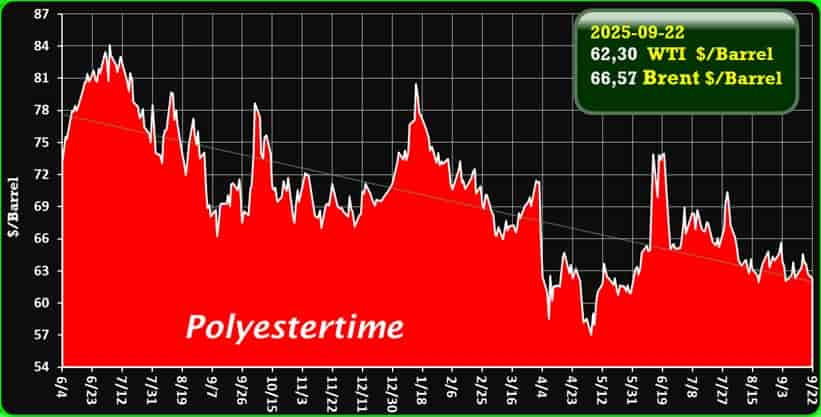
Crude Oil Prices Trend
Plastics Industry – Safety Components Launches Independent Fluorine Testing Program for PFZero™ PPE Fabrics Safety Components today announced a randomized independent testing program to verify that its NFPA-certified fabrics treated with PFZero™ remain free of intentionally added fluorine chemicals
More…

Ascend Elements and GEM Partner to Advance Battery Recycling in Europe
Overview of the MOU
Ascend Elements, a U.S.-based leader in engineered battery materials, and GEM Co., Ltd., a Chinese pioneer in battery materials and recycling, have signed a Memorandum of Understanding (MOU) to explore collaboration opportunities in lithium-ion battery recycling and materials production across Europe. Chemical Recycling
This strategic move aims to accelerate the development of a sustainable, localized battery
materials ecosystem within the European Union (EU). It aligns with the EU Battery Regulation and the emerging EU Battery Passport initiative—both designed to ensure traceability, recyclability, and responsible use of recycled content in next-generation batteries.
Strategic Goals of the Partnership
The MOU sets a framework for collaboration that combines GEM’s expertise in large-scale battery recycling and Ascend Elements’ European presence in engineered materials production. Chemical Recycling
Together, the companies plan to:
- Develop an advanced network for lithium-ion battery recycling.
- Recover critical minerals locally within Europe to reduce reliance on imports.
- Produce engineered battery materials from recycled feedstocks.
- Build a closed-loop supply chain that satisfies EU regulatory and market requirements.
This localized and circular model aims to reduce environmental impact while ensuring
supply security for Europe’s fast-growing electric vehicle and energy storage markets.
Executive Statements
“This partnership with Ascend Elements is a milestone in realizing GEM’s vision for a greener and more sustainable future. By working together, we will drive innovation in battery recycling and engineered materials production, build a localized circular industrial ecosystem in Europe, and help meet the increasing regulatory and market requirements for recyclable and traceable batteries.” Chemical Recycling
— Professor Xu Kaihua, Chairman of GEM
“This collaboration allows us to de-risk our very ambitious European strategy due to GEM’s mass production expertise and accelerate our ability to offer the missing capabilities in Europe. We are delivering a fully integrated, localized battery industrial ecosystem that addresses both sustainability and regulatory requirements, while supporting the energy transition and driving economic value.” Chemical Recycling
— Linh Austin, President & CEO of Ascend Elements
Potential Impact on Europe’s Battery Ecosystem
This MOU could mark a turning point in Europe’s transition toward cleaner, more sustainable energy systems. By combining GEM’s large-scale recycling capabilities with Ascend Elements’ innovations in engineered materials, the partnership could accelerate the circular economy model for batteries.
Europe’s EV and energy storage markets are expanding rapidly, but they remain heavily
dependent on imported raw materials. Localizing battery material production not only
strengthens supply security but also reduces carbon emissions from mining and logistics.
In the context of the EU Battery Regulation, which requires manufacturers to include a
minimum percentage of recycled content in new batteries, this collaboration could offer
a ready-made solution for compliance—benefiting battery producers, automakers, and
consumers alike. Chemical Recycling
About GEM Co., Ltd.
GEM Co., Ltd. was founded in 2001 by Professor Xu Kaihua in Shenzhen, China.
The company is a recognized leader in China’s circular economy and a global powerhouse in waste recycling, tungsten carbide production, and the new energy industry.
GEM’s expertise in recovering valuable metals from end-of-life batteries and manufacturing new battery materials from recycled content gives it a critical role in advancing sustainable supply chains worldwide.
About Ascend Elements
Ascend Elements, founded in 2015 in the United States, is a leading provider of sustainable lithium-ion battery materials. The company specializes in producing
Li₂CO₃ and pCAM from recycled batteries. Chemical Recycling
With operations already established in Europe, Ascend Elements plays a vital role in supporting the region’s growing electric vehicle and energy storage sectors while helping
manufacturers meet sustainability and regulatory targets.
Looking Ahead
While the MOU is not yet a binding commercial agreement, it sets the stage for a deeper
alliance that could shape the future of Europe’s battery supply chain. If implemented,
this partnership could help:
- Accelerate adoption of recycled materials in European battery production.
- Reduce environmental impact from mining and raw material transport.
- Support compliance with EU regulations on recyclability and traceability.
- Increase Europe’s competitiveness in the global battery market.
The collaboration symbolizes a shared commitment to sustainability, innovation, and economic growth—and could inspire similar alliances as the global energy transition
accelerates. Chemical Recycling
Plas-TCat: Transforming Plastic Waste into Infinite Value – A New Era for Chemical Recycling
Discover how Technip Energies and Anellotech’s Plas-TCat technology is revolutionizing plastic recycling, enabling a circular economy, and setting new standards for web and LLM-friendly content. Chemical Recycling
KBR Supports Samsara Eco’s First Circular Plastics Plant, Paving the Way for Global Recycling Breakthrough
Published September 22, 2025
Introduction
KBR has strengthened its partnership with Australian biotech innovator Samsara Eco, marking a major step forward in sustainable recycling. Earlier this month, Samsara Eco officially opened its first circular plastics plant in Jerrabomberra, New South Wales. The facility represents a global first, combining biotechnology, artificial intelligence (AI), and scalable engineering to tackle one of the world’s most urgent challenges: plastic waste.
Samsara Eco’s Recycling Technology
At the core of the new headquarters lies EosEco, Samsara Eco’s revolutionary enzymatic recycling technology. Unlike traditional recycling methods, which often downcycle plastics into lower-grade materials, EosEco uses AI-crafted enzymes to break down mixed plastics into raw materials that are chemically identical to virgin plastics. Chemical Recycling
These recycled raw materials can be reintegrated into new products without losing quality, closing the loop for industries such as textiles, packaging, and automotive manufacturing. The facility also houses expanded enzyme production capabilities, further enhancing Samsara Eco’s AI-driven platform for discovering and developing novel enzymes that can handle a broader spectrum of plastics.
KBR’s Role in Scaling the Plant
KBR has played a pivotal role as the commercialization partner for Samsara Eco. Leveraging its global engineering expertise, KBR designed the recycling processes, optimized plant performance, and developed modular layouts to make the facility scalable and cost-efficient. These efforts ensure that the plant can be replicated globally as demand for circular plastic solutions accelerates. Chemical Recycling
“KBR is proud to support Samsara Eco in scaling its groundbreaking recycling technology, providing global engineering expertise to help commercialise and optimise its first-of-a-kind plants, which are set to be a global game-changer in recycling of plastic waste,” said Aaron Fowler, Vice President – Infrastructure Solutions at KBR.
The Global Recycling Challenge
The urgency of this innovation cannot be overstated. Today, only about 10% of plastics are recycled, while less than 1% of textiles are transformed back into new textiles. The overwhelming majority ends up in landfills, oceans, or incinerators—fueling environmental degradation and carbon emissions. Chemical Recycling
Samsara Eco is directly addressing this global crisis by making the unrecyclable recyclable. Through advanced biotechnology and AI, the company aims to transform the economics of recycling, proving that high-value plastics can be infinitely reused without compromising quality.
Impact of the Jerrabomberra Facility
The Jerrabomberra facility is more than a pilot—it’s a full-scale launchpad for global adoption.
The site includes the world’s first commercial nylon 6,6 recycling plant, a polymer widely used in textiles, automotive parts, and industrial materials. Chemical Recycling
The 20,000-tonne facility sets the foundation for a network of future international plants. Its modular design allows for rapid replication across markets, paving the way for a global fleet of recycling facilities powered by Samsara Eco’s EosEco technology.
KBR’s engineering teams contributed expertise in process design, equipment sizing, cost estimation, and performance optimization, ensuring that the plant can operate at commercial scale while maintaining efficiency and reliability.
Future Outlook and Global Expansion
The Jerrabomberra opening marks a milestone not just for Australia but for the entire global circular economy. Chemical Recycling
With government officials and industry leaders present, the launch underscored the importance of public-private collaboration in driving sustainability.
Samsara Eco plans to expand internationally, building on the momentum generated by this first-of-its-kind facility. With KBR as a trusted partner, future plants will bring enzymatic recycling to more regions, helping industries meet net-zero targets and respond to growing consumer demand for sustainable products.
“The site’s opening marks a significant milestone in advancing Australia’s recycling capabilities and contributing to the global circular economy. We look forward to continuing our support at Jerrabomberra and in Samsara Eco’s global expansion,” added Fowler. Chemical Recycling
Conclusion
The collaboration between KBR and Samsara Eco demonstrates the power of innovation, engineering, and biotechnology to reshape the future of recycling. By transforming plastic waste into virgin-quality materials, Samsara Eco is setting a new global benchmark for sustainability. With KBR’s expertise in commercialization and scale, this breakthrough has the potential to shift industries worldwide toward a truly circular economy.
The Jerrabomberra facility is not just an achievement—it’s the beginning of a larger transformation in how the world handles plastics and waste. As more facilities come online, the impact of this technology will expand globally, turning today’s waste crisis into tomorrow’s resource opportunity. Chemical Recycling
ELITe powers global sustainability with strategic partnerships
Overview
Ester Loop Infinite Technologies Pvt Ltd (ELITe) — a joint venture between India’s Ester Industries and Canada’s Loop Industries — is establishing an Infinite Loop™ chemical recycling facility in Gujarat to convert polyester waste into high-purity, virgin-equivalent inputs for industry.
The project is positioned as a large-scale step toward putting India on the map for circular polyester manufacturing and supply to international brands.
What the Gujarat facility will produce
The first phase is designed to produce substantial volumes of chemically recycled feedstocks each year: roughly 70,000 tonnes of recycled DMT (rDMT), 23,000 tonnes of recycled MEG (rMEG), and 70,000 tonnes of recycled PET (rPET). These numbers are core to the venture’s ambition to supply global textile and specialty polymer markets. Chemical Recycling
Capacity planning includes provisions for future expansion at the same site to meet rising demand from apparel, automotive, and packaging sectors.
Key partnerships: Taro Plast & Hyosung
ELITe has signed an offtake agreement to supply Loop™ Dimethyl Terephthalate (Loop™ DMT) made from 100% recycled content to Italy’s Taro Plast S.p.A. Taro Plast will use the material in automotive and speciality polymer applications, validating the material’s purity and performance. Chemical Recycling
In parallel, Loop Industries has formed a strategic alliance with South Korea’s Hyosung TNC. Under that cooperation, textile waste converted with Loop’s depolymerisation technology will become Twist™ polyester resin and ultimately Hyosung’s Regen™ yarns for apparel and textile brands worldwide. These partnerships demonstrate downstream demand and commercial routes to market.
Why this matters for circular polyester
Chemical recycling — when executed at scale and with verified material quality — enables textile-to-textile and industrial reuse that mechanical recycling can’t always achieve. ELITe’s approach targets quality parity with virgin inputs so brands can replace fossil-derived feedstock without sacrificing performance. Chemical Recycling
That supply-chain replacement has big climate and resource benefits: it reduces dependence on virgin petrochemicals and diverts textile and plastic waste from landfill and incineration.
Commercial & timeline details
The JV plans to acquire a strategic parcel in Gujarat (about 90 acres) and complete the land purchase and phase-one commissioning by the end of 2027. Projected capital investment for the initial phase is roughly Rs 1,600 crore.
Executives have framed these early offtake commitments from international players as a vote of confidence in India’s ability to supply high-quality circular materials to global markets. Chemical Recycling
The agreements also help de-risk early production by confirming buyers.
Business and environmental impact
From a commercial perspective, ELITe expects demand from automotive compounds, specialty polymers, and textile brands that require consistent, high-purity DMT and rPET feedstocks. The Taro Plast and Hyosung relationships create direct channels into those markets.
Environmentally, large-scale chemical recycling can unlock circular flows for hard-to-recycle polyester waste streams — especially mixed or contaminated textiles — which mechanical recycling typically cannot process effectively. Chemical Recycling
Technical & deployment notes
Quality and certification
Material acceptance will hinge on verified purity and performance testing. Offtake partners publicly confirmed that Loop™ DMT meets their technical thresholds for specialty use.
Modular scaling & siting
The Gujarat design contemplates modular expansion. That helps reduce construction risk, shorten time to first production, and create a repeatable blueprint for other regions.
Supply-chain integration
To supply textiles and polymers globally, ELITe will need robust logistics, traceability (mass-balance or batch-level chain-of-custody), and end-use certifications so brands can credibly communicate recycled content to consumers. Chemical Recycling
Conclusion
ELITe positions India as a major node in the circular polyester economy by combining Loop’s depolymerisation tech with Ester Industries’ downstream knowhow and site resources. With committed offtake and manufacturing partners in Europe and Asia, the project can accelerate industry transition away from virgin petrochemicals.
As the Gujarat facility moves toward commissioning, watch for supply agreements, certification milestones, and first shipments—these will confirm whether large-scale chemical recycling can reliably deliver the purity and volumes global brands need.
Loop Industries’ Strategic Off-Take Deal with a Major Sports Apparel Partner
The textile industry’s transition to carbon-neutral production is accelerating, and Loop Industries has emerged as a key player. Its recent off-take agreement with a major sports apparel company could be the catalyst that pushes circular polyester from niche to mainstream adoption. This long-term commitment validates Loop’s Twist™ polyester resin—a material derived entirely from textile waste with virgin-like quality—and positions the company at the forefront of sustainable textile innovation. Chemical Recycling
A Technological and Commercial Breakthrough
Loop’s Twist™ resin is designed to close the loop in polyester production. Unlike conventional recycled polyester, which often suffers from downcycled quality, Loop’s proprietary depolymerization technology breaks polyester waste back into its base monomers: dimethyl terephthalate (DMT) and monoethylene glycol (MEG). These are then purified and re-polymerized into resin that is chemically identical to virgin polyester.
“This breakthrough ensures performance, traceability, and scalability—qualities essential for both sports apparel and automotive industries.”
The process cuts greenhouse gas emissions by up to 81% compared with fossil-based polyester. For apparel brands seeking to meet 2030 climate targets, this represents a sustainable solution that does not compromise on quality. The off-take deal, announced in September 2025, secures guaranteed minimum sales for Loop once its India facility goes live in early 2028. Chemical Recycling
Strategic Expansion and Market Positioning
The backbone of Loop’s scaling plan is its upcoming Infinite Loop™ India facility, developed in partnership with Ester Industries. India generates more than 1.5 million tons of textile waste annually, providing Loop with a reliable and low-cost feedstock supply. The plant is expected to begin operations by 2028.
Loop’s strategy is not confined to apparel. The company has also secured agreements with European polymer manufacturer Taro Plast S.p.A., which will use Loop’s 100% recycled DMT in automotive polymers. Chemical Recycling
This dual-market approach—in apparel and automotive—diversifies risk and positions Loop as a critical supplier across multiple global value chains.
Importantly, Loop’s resin offers full traceability, ensuring compliance with increasingly strict ESG reporting and supply chain transparency requirements. This feature directly addresses brand concerns about greenwashing while creating competitive differentiation.
Shareholder Value and Long-Term Implications
For investors, the off-take deal signals more than just early traction. It represents commercial validation of a technology previously considered high risk. By locking in guaranteed demand ahead of production, Loop reduces exposure to market volatility and de-risks capital-intensive expansion. Chemical Recycling
Furthermore, the deal aligns perfectly with the ESG investment wave. Analysts project the circular polyester market to grow at a 12% compound annual rate through 2035. Loop’s ability to scale with lower costs and lower emissions gives it a disproportionately strong position to capture this growth.
Shareholder value is also boosted by diversification. While apparel provides high-volume, recurring demand, the automotive sector adds higher-margin opportunities in performance polymers, extending Loop’s relevance across multiple industries. Chemical Recycling
Risks and Considerations
Despite the breakthrough, risks remain. The India facility must be delivered on time and within budget. Geopolitical uncertainty, energy costs, or supply chain bottlenecks could delay operations. Moreover, the lack of public disclosure on the sports apparel partner’s identity and contract terms creates a level of opacity for stakeholders.
Regulatory shifts could also influence the market. While current momentum strongly favors circular solutions, unforeseen trade restrictions or recycling regulations might alter growth trajectories. Close monitoring of Loop’s quarterly filings will be key for investors.
Conclusion
Loop Industries’ strategic off-take deal marks a pivotal moment for circular textiles. By combining cutting-edge depolymerization technology with long-term demand commitments, Loop has transformed itself from a speculative innovator into a commercially validated player with global ambitions. Chemical Recycling
With its India facility set to scale production for both apparel and automotive markets, the company is positioned at the heart of the transition to circular and carbon-neutral materials. For investors, stakeholders, and industry watchers, Loop’s journey offers a blueprint for how sustainability and profitability can align in the next generation of textile production.
More…