Crude Oil Prices Tumble Amid Cooling Middle East Tensions — Powerful Market Shift Signals Opportunity for Traders, But Raises Fear for Global Energy Growth Outlook 10-10-2025
Crude Oil Prices Outlook — 10 October 2025
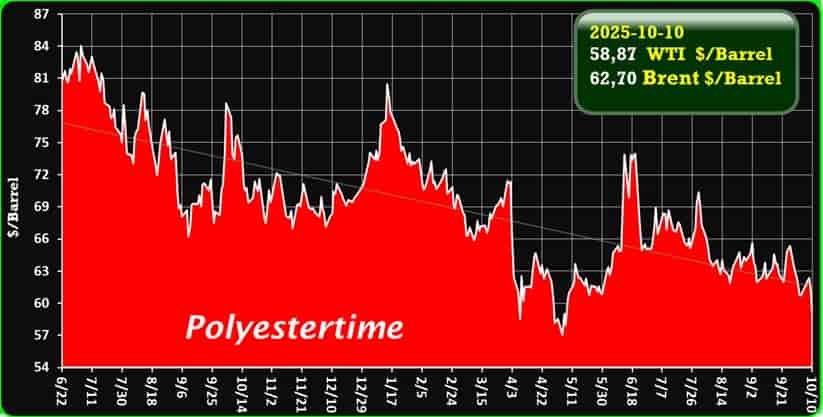
As of 10 October 2025, global crude oil prices are navigating a complex mix of supply, demand, and geopolitical forces. After a recent rally, oil has softened slightly following reduced risk premiums in the Middle East, cooling some of the prior upside pressure.
Below is a snapshot of today’s market, what’s driving movements, and what to watch going forward.
⛽ Current Crude Oil Prices & Market Snapshot
-
Brent crude is trading near USD 65.09 per barrel, down about 0.19 % from the prior day Trading Economics.
-
Front-month Brent futures show “What to Watch in the Coming Days for Crude Oil Prices” around USD 65.31 in early trading MarketWatch.
-
Earlier this week, prices had jumped ~1.5 % after OPEC+ announced a modest output increase Reuters+1, though gains have since cooled.
-
The easing of regional tensions (e.g. the first phase of a Gaza ceasefire) has reduced geopolitical risk, which weighed on prices by removing some of the “risk premium” baked into crude valuations Reuters+2Reuters+2.
So, while there has been a technical rebound intraday Economies.com, the overall trend is cautious amid weakening demand signals and overhangs from added supply.
What’s Behind the Moves in Crude Oil Prices?
Understanding today’s oil pricing requires tracking several interacting dynamics:
1. OPEC+ Supply Strategy
-
OPEC+ recently agreed to increase output by 137,000 barrels per day (bpd) starting November 2025 Financial Times+2Reuters+2.
-
However, the increase was smaller than some market participants expected, which supported price resilience. Reuters+1
-
That said, many producers historically under-deliver on quotas, limiting the real supply impact. Financial Times+1
2. Geopolitical Tension & Risk Premiums
-
The recent Gaza ceasefire eased oil’s “war premium,” leading to downward pressure on prices Reuters+2Reuters+2.
-
Ongoing U.S. sanctions on Iranian petroleum exports add supply constraint risk, which keeps a floor under prices Financial Times.
-
Russia has also extended a gasoline export ban to relieve domestic inflation pressure, complicating its oil trade dynamics Reuters.
3. Demand & Macro Signals
-
Global economic growth is softening, which places downward pressure on oil demand forecasts.
-
The U.S. continues to consume oil at near-record levels Reuters, but broader demand growth is not strong enough to absorb large incremental supplies.
-
A strengthening U.S. dollar also makes dollar-priced commodities like crude more expensive in other currencies, further dampening demand. Reuters+1
4. Inventory & Futures Structure
-
Inventories remain elevated in many regions, which acts as a brake on upside price momentum.
-
The futures curve exhibits contango (i.e. later contracts priced higher than near ones), which incentivizes storage strategies Wikipedia.
-
Price technicals show a break below key moving averages (e.g. EMA50), which signals lingering downward pressure unless reversed quickly Economies.com+1.
Near-Term Crude Oil Prices Outlook & Scenarios
Based on current information and forecasts:
-
Brent may attempt to test resistance around USD 66.55, but any rally could be capped unless demand surprises materially upward FOREX24.PRO.
-
If pressure yields, support zones for crude oil prices near USD 62.5 to USD 63.35 could come into play. FOREX24.PRO+1.
-
The U.S. Energy Information Administration (EIA) forecasts average Brent prices may fall to about USD 62/b in Q4 2025 and nearer USD 52/b by 2026 U.S. Energy Information Administration.
-
A further easing of geopolitical tensions or supply disruptions (e.g. Middle East, shipping chokepoints) could inject volatility back into prices.
Implications Across the Energy Value Chain
-
Refineries / Fuel Markets: Lower price pressures may give refineries more margin flexibility; retail fuel costs may see modest relief if passed through.
-
Exporters / Producers: Countries heavily reliant on oil revenue may face pressure on balance sheets if sustained declines materialize.
-
Importers: Nations that import crude may benefit from lower costs, though currency effect and transport margins matter.
-
Investors / Traders: With technical readings weak and seasonal headwinds ahead, speculative positioning may tilt toward short or neutral stances.
What to Watch in the Coming Days for Crude Oil Prices
-
OPEC+ compliance & announcements — whether members deliver or undercut quotas.
-
Geopolitical flashpoints — developments in Middle East, Iran, or shipping lanes (e.g. Strait of Hormuz).
-
Macro data surprises — inflation, industrial output, mobility indicators in major consuming economies.
-
U.S. EIA / IEA weekly inventory reports — upward surprises may further weaken sentiment.
-
Currency & interest rate moves — especially U.S. rate expectations and USD strength.