Oil price slides modestly amid trade-deal optimism yet underlying oversupply concerns linger — what the 64,05$/b and 60,25$/b readings signal 30-10-2025
Oil price – Introduction
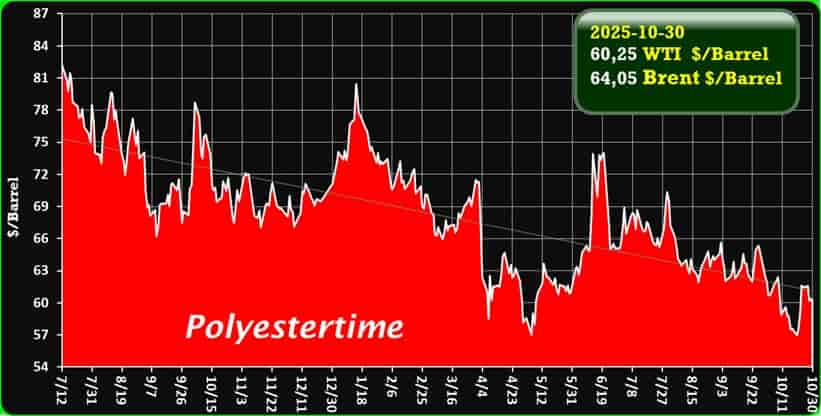
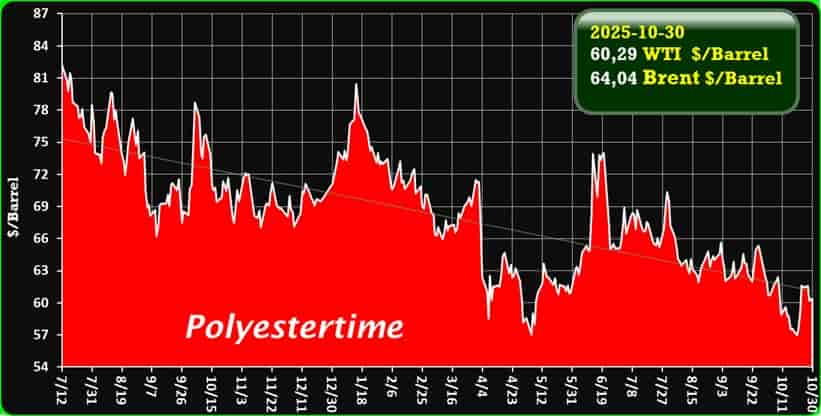
Today’s snapshot of the global oil market shows a Brent crude oil price at approximately $64,05 per barrel and **West Texas Intermediate (WTI) crude at about $60,25 per barrel.
While the market has been buoyed by signs of easing trade tensions, particularly between the U.S. and China, caution remains due to persistent concerns around supply-demand imbalance.
In this article we dig into the key drivers of the oil price today, interpret the data and draw out implications for the near term.
Current price table
| Benchmark | Price (USD/barrel) | Comment |
|---|---|---|
| Brent | 64,05 | Reflecting global benchmark crude, slightly higher than recent lows |
| WTI | 60,25 | U.S. light-sweet crude, showing similar trend but lower than Brent |
(Note: The figures are approximate for 30 October 2025.)
What’s driving the oil price today?
1. Trade-deal optimism
News that the U.S. and China reached a framework agreement — with the U.S. cutting tariffs on Chinese goods from 57% to 47% in return for China resuming U.S. soybean imports and maintaining rare-earth exports — has given markets a modest boost. Reuters+2WKMG+2
The logic: easing trade tensions could support global growth, and therefore demand for oil.
Yet the reaction is muted — indicating that while optimism exists, the market remains sceptical about how much demand growth will follow.
2. Inventory signals and supply risk
U.S. crude inventories unexpectedly declined by about 6.86 million barrels in the week ending 24 October, according to the Energy Information Administration (EIA). Trading Economics
This draw provides some support to prices. On the other hand, global stock-builds remain concerning: the International Energy Agency (IEA) recently noted that observed inventories rose sharply, pointing to a looming oversupply. IEA+1
3. Oversupply and production risks
Analysts at Bank of America (BofA) argue that a price floor near $55 per barrel may be forming, but note that if trade tensions escalate or production ramps up, Brent could drop below $50. Rigzone
Moreover, producers in the Organization of the Petroleum Exporting Countries + alliance are under pressure to boost output, and markets are cautious that supply may outpace demand, weighing on the “oil price” theme. Reuters+1
Interpreting the current levels
With Brent at ~$64,05 and WTI at ~$60,25, what’s the market saying?
-
The gap between Brent and WTI reinforces that the global benchmark still commands a premium — but both remain well below historical highs, underscoring caution.
-
The price levels suggest that the market is expecting range-bound movement in the short term, rather than runaway gains. For instance, in recent commentary, $60 and $58 per barrel were cited as key support levels for Brent. Reuters
-
On the upside, resistance around ~$72 per barrel is seen by some analysts as the next barrier if demand improves. Reuters
-
The modest decline in prices today shows that the easing trade tensions are not being treated as a full demand re-acceleration signal, but rather a cautious “positive” event in a still fragile market.
What this means for stakeholders
-
Consumers & transport sector: A moderate oil price near $60-65 helps keep downstream fuel costs in check — good for households and businesses sensitive to energy costs.
-
Producers & energy companies: Margin pressure remains for higher-cost producers. Sustained movement below $60 may prompt production cuts or cost rationalisation.
-
Investors & market watchers: The “oil price” is signalling that while things are stabilising, the bigger upside will likely require stronger demand signals — such as robust global growth or meaningful supply disruption.
-
Policy makers: For major oil-importing countries, moderate oil price means some breathing room for inflation and fiscal budgets; for exporting governments, revenue risks persist.
Outlook & key things to watch
-
Global demand growth – Any clear signs that China or the U.S. are accelerating oil consumption would shift sentiment.
-
OPEC+ / producer behaviour – Output decisions, especially any surprise cuts or increases, will matter.
-
Geopolitical disruptions – Middle East tensions, sanctions, or logistical chokepoints could swing the “oil price” higher quickly.
-
Inventory data – Weekly U.S. inventory releases and IEA/OECD data will continue to drive short-term sentiment.
-
Macroeconomic indicators – Growth, inflation and interest-rate signals feed into demand expectations and hence oil valuation.
Conclusion
Today’s oil price snapshot — Brent at ~$64,05 and WTI at ~$60,25 — reflects a market at a cautious crossroads.
Optimism from easing trade tensions with China is present, but overshadowed by supply-side risks and demand uncertainty.
For now, the “oil price” is likely to remain in a moderate trading range unless a clear catalyst emerges.
Stakeholders from producers to consumers should watch closely for demand signals and policy or supply surprises in the weeks ahead.