Record Disapproval of Trump Hits 60 Percent as Inflation, Tariffs and Foreign Policy Concerns Intensify Before State of the Union Address 22-02-2026
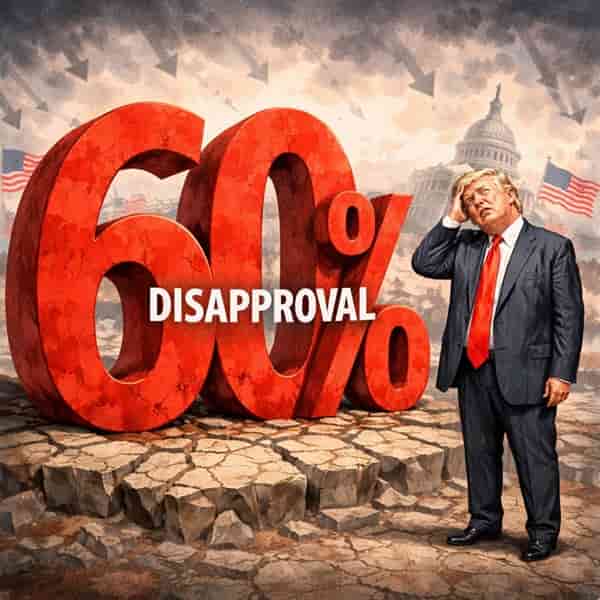
Trump Disapproval Reaches Record 60 Percent in Latest US Poll
Trump disapproval has climbed to a record 60 percent, according to a new national survey released by ABC News in partnership with The Washington Post and Ipsos. The findings arrive just days before the State of the Union address, underscoring mounting public dissatisfaction with the president’s performance.
The poll, conducted between February 12 and 17 on a sample of 2,589 US adults, highlights broad frustration across key policy areas. While political polarization remains deeply entrenched, the data suggests that Trump disapproval has expanded beyond partisan opposition and now reflects wider economic and geopolitical concerns.
For political observers, the numbers represent a significant moment in the second term, as public confidence appears to be weakening rather than stabilizing.
Inflation and Tariffs Drive Economic Frustration
The strongest driver of Trump disapproval is inflation. According to the survey, 65 percent of Americans disapprove of how the administration is handling rising prices. Persistent cost-of-living pressures continue to weigh heavily on households, affecting food, housing, energy, and healthcare expenses.
Tariffs are another key flashpoint. Sixty-four percent of respondents express dissatisfaction with tariff policies, which many associate with higher consumer costs and trade tensions. Although tariffs were framed as a tool to protect domestic industries, critics argue that the broader economic impact has been inflationary.
These economic indicators significantly shape overall Trump disapproval, as voters tend to prioritize financial stability above other political considerations. When economic anxiety rises, presidential approval ratings often decline accordingly.
Foreign Relations and Immigration Add to Discontent
Beyond domestic economic concerns, foreign relations represent another area contributing to Trump disapproval. Sixty-two percent of Americans disapprove of the administration’s management of international affairs.
Global instability, shifting alliances, and debates over military engagement appear to have eroded confidence among a majority of voters. Notably, 54 percent of respondents say they do not support the use of armed forces to force changes in other countries. Only 20 percent endorse such an approach.
Immigration management also remains a divisive issue. Fifty-eight percent of those surveyed disapprove of current policies. While immigration has historically mobilized strong partisan bases, the data suggests dissatisfaction cuts across different voter segments.
Together, these policy areas reinforce the broader pattern of Trump disapproval reflected in the national numbers.
Disapproval Trend Rising Since Start of Term
The survey indicates that Trump disapproval has increased gradually over time. Last October, the disapproval rate stood at 59 percent. Since the beginning of the current term in February 2025, it has risen by seven percentage points.
This upward trajectory signals sustained erosion of public confidence rather than a short-term fluctuation. While approval ratings can shift rapidly in response to major events, the steady rise in Trump disapproval suggests structural concerns among the electorate.
Interestingly, approval ratings have also shifted. The survey notes a movement from 45 percent approval down to 39 percent. The widening gap between approval and disapproval underscores growing polarization and dissatisfaction.
As the State of the Union approaches, these figures frame a politically challenging landscape for the administration.
Democrats Struggle to Capitalize on Discontent
Despite high Trump disapproval levels, the opposition party is not seeing a proportional surge in public trust. When respondents were asked who is better equipped to handle the country’s main problems, only 31 percent chose Democrats in Congress.
By comparison, 33 percent said Trump was better suited to address those challenges. Another third of Americans selected neither party.
These numbers reveal a broader crisis of confidence in political leadership overall. Trump disapproval does not automatically translate into enthusiasm for Democratic leadership. Instead, many voters appear skeptical of both parties’ ability to manage inflation, trade, and foreign policy effectively.
This dynamic complicates electoral forecasting, as voter dissatisfaction is not consolidating around a single alternative.
Perception of Disconnection from Voter Concerns
A striking 64 percent of Americans believe the president is disconnected from the country’s main concerns. This perception significantly amplifies Trump disapproval, as voters often evaluate leadership not only on policy outcomes but also on perceived empathy and responsiveness.
When economic hardship intensifies, public expectations for visible leadership increase. If voters feel unheard or misunderstood, dissatisfaction tends to deepen regardless of ideological alignment.
This perception gap may become a central theme in upcoming political messaging and campaign strategies.
Divisions Within the Republican Base
The survey also reveals internal divisions among Republicans. Fifty-four percent of conservative sympathizers identify as supporters of the MAGA movement, while 42 percent say they do not align themselves with it.
Among those who distance themselves from the MAGA label, a majority disapproves of the president’s handling of inflation, tariffs, and foreign relations. This internal split suggests that Trump disapproval is not confined to opposition voters but also exists within segments of the broader conservative electorate.
Party cohesion remains a critical factor in sustaining political momentum. When divisions emerge within a core support base, policy debates can intensify and electoral calculations become more complex.
Political Implications Ahead of the State of the Union
The timing of the poll adds strategic significance. With Trump disapproval at 60 percent, the upcoming State of the Union address represents an opportunity to recalibrate messaging and attempt to regain public confidence.
Presidential addresses traditionally aim to project stability, outline economic strategies, and reinforce foreign policy priorities. However, the effectiveness of such speeches depends on whether voters perceive tangible solutions rather than rhetorical reassurances.
The poll data suggests that economic management, inflation control, and international diplomacy will likely dominate public scrutiny in the months ahead.
Understanding the Broader Context
High Trump disapproval levels reflect a broader climate of political fatigue and economic strain. Inflation, trade tensions, and global instability are issues that transcend party lines and shape everyday realities for millions of Americans.
At the same time, low trust in both major parties indicates systemic challenges within the US political system. Voters appear increasingly skeptical of institutional leadership, regardless of affiliation.
Whether Trump disapproval stabilizes or continues rising may depend on measurable improvements in economic indicators and shifts in foreign policy outcomes.
For now, the data presents a clear snapshot of public sentiment: dissatisfaction is widespread, bipartisan trust is fragile, and political uncertainty remains elevated.
More…