Green Hydrogen – Now NIO’s battery swap could truly become global 04-12-2023 - Archive
Green Hydrogen
Polymers Textiles – Europe’s Imperative: Countering Russia’s Bid for Hydrogen Market Supremacy

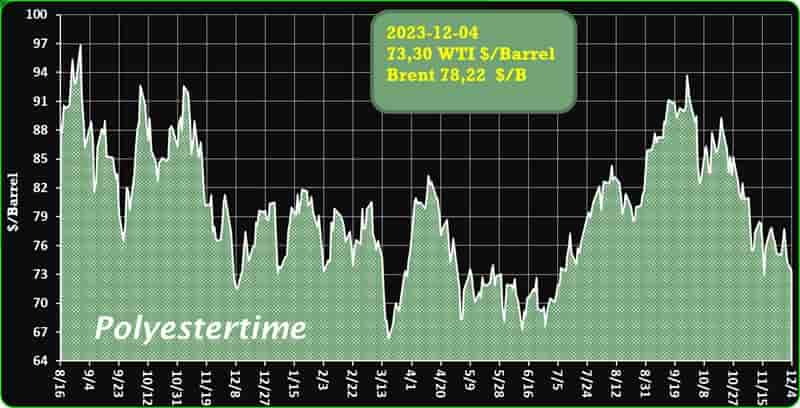
Crude Oil Prices Trend
Now NIO’s battery swap could truly become global
NIO, the Chinese electric vehicle company, is expanding its global reach by signing a strategic agreement with Geely. This collaboration could potentially introduce NIO’s battery swap technology to electric cars from various brands owned by Geely, including Volvo, Polestar, Lotus, smart, and Zeekr. NIO has already deployed over 2,000 battery swap stations in China and is expanding its presence internationally. Green Hydrogen
The partnership involves a joint approach between Geely and NIO in handling investments, construction, and design of battery swap stations. Both companies aim to enhance the efficiency and versatility of battery swap systems, intending to offer this technology in all future electric cars from the associated brands. The agreement is seen as mutually beneficial, allowing NIO to diversify investments and increase profitability, while Geely can quickly expand its battery swap station network, currently comprising 300 active points.
This collaboration has potential implications for the European market, where Geely’s ownership of brands with strong traditions and significant market share could make battery swap technology more widely adopted. The agreement reflects a renewed interest in battery swap technology, which had previously been considered by various brands but is now gaining traction once again. Green Hydrogen
BASF advances 54-MW green hydrogen project
BASF SE, the German chemical giant, has achieved a major breakthrough with the formal approval of $136.2 million state grant dedicated to the establishment of a green hydrogen plant at its Ludwigshafen headquarters, said Chemanalyst.
This financial endorsement signals a critical advancement for the Hy4Chem-EI project, a collaborative endeavor between BASF and Siemens Energy, propelling it into the eagerly anticipated construction phase.
The funding for this pioneering project will be sourced from the German Federal Ministry for Economic Affairs and Climate Action. Green Hydrogen
The Hy4Chem-EI initiative is designed to introduce a cutting-edge 54-megawatt proton exchange membrane electrolyser, with the capacity to produce a substantial 8,000 metric tons of hydrogen annually.
The electricity essential for hydrogen generation will be derived exclusively from renewable energy sources, aligning the project with a sustainable and environmentally conscious approach.
The primary strategic objective for the hydrogen produced at the Ludwigshafen facility is to serve as a fundamental raw material for the decarbonization of BASF’s chemical production processes. Green Hydrogen
Additionally, a portion of the hydrogen output will be earmarked for deployment in transportation applications within the Rhine-Neckar Metropolitan Region.
Anticipated to be among the largest of its kind in Germany upon activation, the Ludwigshafen electrolyser is expected to make significant contributions to the nation’s green hydrogen landscape.
The commissioning of this innovative facility is currently scheduled for the year 2025, marking a pivotal milestone in the transition towards sustainable and eco-friendly energy solutions.
This recent funding approval represents a crucial milestone for the Hy4Chem-EI project, occurring approximately one year after the European Commission (EC) granted Germany the necessary approval to allocate a substantial grant to support this groundbreaking initiative. Green Hydrogen
The collaborative efforts of BASF and Siemens Energy in the Hy4Chem-EI project underscore their commitment to pioneering advancements in the realm of green hydrogen technology.
As the global community intensifies efforts to combat climate change and transition towards more sustainable energy solutions, projects such as Hy4Chem-EI take center stage in contributing to a cleaner and greener future.
The support garnered from governmental bodies further underscores the recognition of the project’s significance in advancing the green hydrogen agenda. Green Hydrogen
Toppan breaks ground on new plant in Czech Republic
Bolstering barrier film supply capabilities in Europe to meet rising global demand for eco-friendly packaging
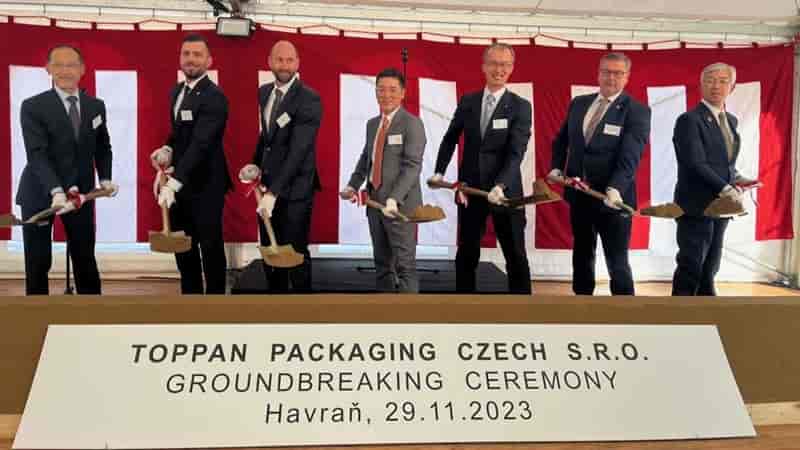
Toppan Packaging Czech, a Toppan Group company, has held a groundbreaking ceremony to launch construction of a new plant in Most in the Ústí nad Labem region of the Czech Republic. The new plant will manufacture GL Barrier transparent barrier film developed and manufactured by the Toppan Group for eco-friendly packaging, a focus of increasing demand around the world. Green Hydrogen
Distinguished guests at the groundbreaking ceremony included His Excellency Hideo Suzuki, ambassador of Japan to the Czech Republic, Czech senator Jan Paparega, and Jan Schiller, governor of the Ústí region. Attendees joined Toppan’s managing executive officer Masahiko Tatewaki and deputy head of global packaging Hiroshi Suzuki in praying for the safe construction of the plant, which is scheduled to launch operations at the end of 2024 as a strategic base catering to increasing needs for sustainable products in the European market.
Masahiko Tatewaki said: ‘I would like to express my great appreciation to everyone who has supported our plan for Toppan’s very first Czech site in the city of Most. Establishing a European base for our GL Barrier business has been a long-standing wish. More than 15 years ago, demand for transparent barrier packaging materials increased from Europe, and our efforts to establish overseas bases began at that time. Our barrier film is not only a sustainable and recyclable product but also uses the most advanced technology in the world. Green Hydrogen
‘We are very proud and excited to support our customers and consumers by providing products from Most to the European market. I believe that by being able to come to the Czech Republic, we will be able to make an even bigger leap forward in this business.
Scientists develop revolutionary process to tackle plastic pollution
Chemists at Northwestern University have developed a new catalyst that “quickly, cleanly and completely” breaks down plastic.
Durable plastic pollution – such as fishing nets – can be easily degraded without leaving harmful by-products thanks to a new high-tech process.
Disturbing images of wildlife – including sea turtles, dolphins and seals – tangled in abandoned fishing nets have become all too common. Green Hydrogen
Scientists explained that the main issue with Nylon-6 – the plastic inside fishing nets, carpet and clothing – is that it’s too strong and durable to break down on its own.
So, once it’s in the environment, it lingers for years, littering waterways, breaking corals and strangling birds and sea life.
Now, chemists at Northwestern University have developed a new catalyst that “quickly, cleanly and completely” breaks down Nylon-6 in a matter of minutes — without generating harmful by-products. Green Hydrogen
They say that the new process doesn’t require toxic solvents, expensive materials or extreme conditions, making it “practical” for everyday applications.
The research team, whose findings were published in the journal Chem. believe it could even perform the first step in upcycling Nylon-6 wastes into higher-value products.
Study senior author Professor Tobin Marks said: “The whole world is aware of the plastic problem.
“Plastic is a part of our society; we use so much of it.
“But the problem is: What do we do when we’re finished with it? Ideally, we wouldn’t burn it or put it into landfills. We would recycle it.
“We’re developing catalysts that deconstruct these polymers, returning them to their original form, so they can be reused.” Green Hydrogen
Up to one million pounds (453,000 kilos) of fishing gear is abandoned in the ocean each year – with fishing nets composed of Nylon-6 making up at least 46 percent of the notorious Great Pacific Garbage Patch, according to the World Wildlife Federation.

Electric Cars – A Glimpse into the Future
In this article, we explore the evolving landscape of Battery Electric Vehicles (BEVs) and look ahead to future possibilities. We provide an overview of emerging technologies, including wireless charging and bidirectional charging, transforming electric vehicles into interactive, mobile power sources.
- Wireless Charging Revolution:
- Overview of wireless charging technologies beyond communication protocols (Wi-Fi, Bluetooth, NFC).
- Inductive electromagnetic induction principle for wireless power transmission. Green Hydrogen
- Practical applications and testing, including BMW’s use in Formula E safety cars.
- Dynamic wireless charging trials in Sweden and Italy, highlighting the Arena del Futuro project near Brescia.
- Multidirectional Energy Networks:
- Concept of future energy networks resembling data networks – multidirectional and optimizing production, flows, and storage.
- Introduction of Vehicle-to-Everything (V2X) technology – V2G, V2B, V2H, and V2L. Green Hydrogen
- Explanation of V2G enabling bidirectional energy flow between vehicles and the grid, maximizing vehicle and energy utilization.
- Potential applications of V2B, V2H, and V2L for direct energy exchange with buildings and homes, as well as utilizing vehicle batteries for various purposes.
- Battery Evolution:
- Focus on battery improvements for electric vehicles, addressing weight, size, and cost concerns.
- Overview of current battery chemistry using lithium, graphite, nickel, manganese, and cobalt. Green Hydrogen
- Exploration of alternative materials like silicon, LFP (lithium-iron-phosphate), and LFMP (additional manganese).
- Mention of future developments, such as glass electrolytes and solid-state batteries.
- Battery Management and Integration:
- Increase in operating voltages from 400V to 800V and potential plans for 900V to reduce wiring and copper requirements.
- Streamlining wiring through wireless technology for individual cell control.
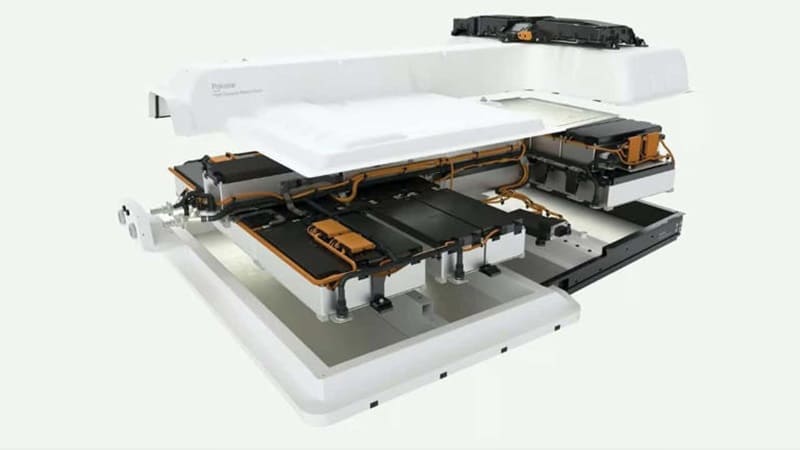
- Simplification of internal battery structure using blade cells and integration into the vehicle’s body for structural support.
- Emphasis on thermal management using thin radiative surfaces or immersing cells in a special dielectric liquid. Green Hydrogen
- Significance of intelligent battery management software, utilizing artificial intelligence for enhanced performance and longevity.
- Inverter and Power Electronics:
- Importance of the inverter in converting DC from the battery to AC for the electric motor.
- Overview of current inverter materials, including SiC (silicon carbide) and future possibilities with GaN (gallium nitride).
- Integration of the inverter into the propulsion unit for efficiency and space optimization.
- Electric Motor Advancements:
- Evolution of electric motor designs, focusing on reducing copper and rare earth material usage. Green Hydrogen
- Introduction of various motor types, including synchronous and asynchronous motors.
- Exploration of Eesm, I2Sm, and Sesm motors as alternatives that eliminate the need for rare earth magnets.
- Integration of the motor, transmission, and power electronics into a single structural unit for improved efficiency and cooling.
In conclusion, the article delves into the ongoing advancements in electric vehicle technologies, providing insights into the future of sustainable and efficient mobility.

OECD projects mild global slowdown in 2024, a bit better 2025 growth
- The latest OECD Economic Outlook projects global GDP growth of 2.9 per cent in 2023, followed by 2.7 per cent in 2024 and 3 per cent in 2025.
- Asia is expected to continue to account for the bulk of global growth in 2024-25, as it has in 2023. Green Hydrogen
- Consumer price inflation is expected to ease gradually back towards central bank targets in most economies by 2025.
Global growth is set to remain modest, with the impact of the necessary monetary policy tightening, weak trade and lower business and consumer confidence being increasingly felt, according to the Organisation for Economic Cooperation and Development’s (OECD) latest Economic Outlook.
The outlook projects global GDP growth of 2.9 per cent in 2023, followed by a mild slowdown to 2.7 per cent in 2024 and a slight improvement to 3.0 per cent in 2025. Asia is expected to continue to account for the bulk of global growth in 2024-25, as it has in 2023. Green Hydrogen
Consumer price inflation is expected to continue to ease gradually back towards central bank targets in most economies by 2025, as cost pressures moderate. Consumer price inflation in OECD countries is expected to decline from 7 per cent in 2023 to 5.2 per cent in 2024 and 3.8 per cent in 2025.
GDP growth in the United States is projected at 2.4 per cent in 2023, before slowing to 1.5 per cent in 2024, and then picking up slightly to 1.7 per cent in 2025 as monetary policy is expected to ease. Green Hydrogen
In the euro area, which had been relatively hard hit by Russia’s war of aggression against Ukraine and the energy price shock, GDP growth is projected at 0.6 per cent in 2023, before rising to 0.9 per cent in 2024 and 1.5 per cent in 2025.
China is expected to grow at a 5.2 per cent rate this year, before growth drops to 4.7 per cent in 2024 and 4.2 per cent in 2025 on the back of ongoing stresses in the real estate sector and continued high household saving rates.
“Over the longer term, our projections show a significant rise in government debt, in part as a result of a further slowdown in growth. Stronger efforts are needed to rebuild fiscal space, also by boosting growth. Green Hydrogen
To secure stronger growth, we need to boost competition, investment and skills and improve multilateral co-operation to tackle common challenges, like reinvigorating global trade flows and delivering transformative action on climate change,” OECD secretary general Mathias Cormann said in a release.
Geopolitical tensions remain a key source of uncertainty and have risen further as a result of the evolving conflict following HAMAS attacks on Israel. Amid heightened geopolitical tensions and a longer-term decline in the trade intensity of growth, the anticipated cyclical pick-up in trade growth could fail to materialise. Green Hydrogen

Ecological Mobility – This new material could change the world 02-12-2023
Green Hydrogen