Who pays Trump tariffs – Trump’s Tariffs Exposed as a Costly Illusion as New Data Shows American Consumers and Businesses Pay the Price, Not Foreign Countries 26-01-2026
Who pays Trump tariffs
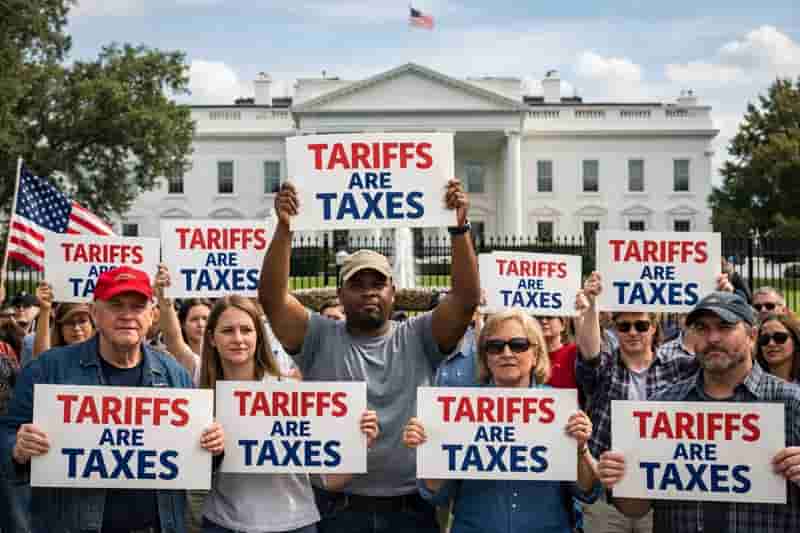
For years, Donald Trump claimed that tariffs imposed on foreign goods were paid by other countries. The message was politically effective and easy to understand. However, new empirical research shows that this claim does not hold up under scrutiny. Trump’s tariffs were not paid by China, Europe, or emerging economies. They were paid overwhelmingly by Americans.
A comprehensive study published by the Kiel Institute for the World Economy provides the most detailed evidence yet on the true economic burden of Trump’s tariffs. By analyzing millions of trade records, researchers found that American importers, businesses, and consumers absorbed nearly the entire cost.
What the Data Actually Shows
The Kiel Institute study examined more than 25 million U.S. shipping records, representing nearly four trillion dollars in trade flows. This dataset allowed economists to track price changes, volumes, and trade diversion effects with unusual precision. Who pays Trump tariffs
The results were striking. Only about 4 percent of the tariff burden was absorbed by foreign exporters through lower prices. The remaining 96 percent was passed directly to buyers in the United States. In practical terms, this means Trump’s tariffs raised costs for American companies importing goods and for households purchasing everyday products.
Customs revenue data reinforces this conclusion. In 2025 alone, U.S. tariff revenues increased by roughly 200 billion dollars. That money did not come from foreign governments or producers. It came from higher prices paid inside the United States. Who pays Trump tariffs
Exporters Did Not Cut Prices
One of the core arguments behind Trump’s tariff strategy was that foreign exporters would be forced to reduce prices to remain competitive in the U.S. market. The data shows this did not happen. Who pays Trump tariffs
The researchers compared export prices to the United States with shipments to other major markets such as Europe and Canada. If exporters had absorbed the tariffs, prices charged to U.S. buyers would have fallen relative to other destinations. Instead, unit prices remained largely unchanged.
What did change was volume. Exports to the United States declined sharply, in some cases by as much as 24 percent. Foreign suppliers shipped fewer goods, not cheaper ones. This pattern confirms that tariffs reduced trade flows without delivering price concessions. Who pays Trump tariffs
Case Study: India and Brazil
The study also analyzed sudden tariff increases imposed on imports from India and Brazil during the summer. Tariff rates jumped between 25 and 50 percent in a short period, creating a natural experiment.
Once again, exporters did not lower prices to compensate. Indian and Brazilian goods became more expensive in the U.S. market, and shipments declined. Exporters redirected sales to other countries instead of subsidizing American buyers.
This behavior underscores a key reality of global trade. When tariffs rise, exporters often have alternatives. Large markets like the European Union or Canada can absorb redirected supply, limiting pressure on prices. Who pays Trump tariffs
Trump’s Tariffs as a Hidden Consumption Tax
From an economic perspective, Trump’s tariffs functioned as a consumption tax on Americans. Unlike income taxes, tariffs are embedded in prices and paid incrementally at the checkout counter or through higher business input costs.
The Kiel Institute researchers concluded that the 200 billion dollars in additional tariff revenue represents a direct transfer of wealth from American households and firms to the U.S. Treasury. Foreign producers did not finance this revenue stream. Who pays Trump tariffs
This finding aligns closely with earlier work by Yale’s Budget Lab and economists at Harvard Business School. Independent analyses consistently show that exporters paid only a small fraction of the total tariff cost.
Long-Term Consequences for the U.S. Economy
The effects of Trump’s tariffs extend beyond immediate price increases. Over time, higher input costs reduce profit margins for American manufacturers and retailers. Some companies respond by raising prices, others by cutting investment or employment. Who pays Trump tariffs
Consumers face higher prices across a wide range of goods, including electronics, machinery, furniture, and household products. These price increases disproportionately affect lower- and middle-income households, which spend a larger share of income on goods.
At the same time, foreign exporters adapt by finding new markets. This weakens U.S. leverage and reduces the intended strategic impact of tariffs.
Why the Tariff Narrative Persists
Despite overwhelming evidence, the idea that foreign countries pay tariffs remains politically attractive. Tariffs are easy to frame as punishment for unfair trade practices, even when the economic mechanics tell a different story. Who pays Trump tariffs
The data-driven reality is less intuitive but far more consequential. Trump’s tariffs did not extract wealth from rivals. They redistributed wealth within the United States, from consumers and businesses to the federal government.
The Bottom Line
The question of who pays Trump’s tariffs is no longer a matter of debate. High-quality empirical evidence shows that Americans paid nearly all the costs. Tariffs reduced trade volumes, raised prices, and acted as a hidden tax on domestic consumption. Who pays Trump tariffs
As policymakers revisit trade strategy, this evidence matters. Tariffs may score political points, but economically they remain a blunt instrument with predictable and costly consequences for the very country imposing them.
More…